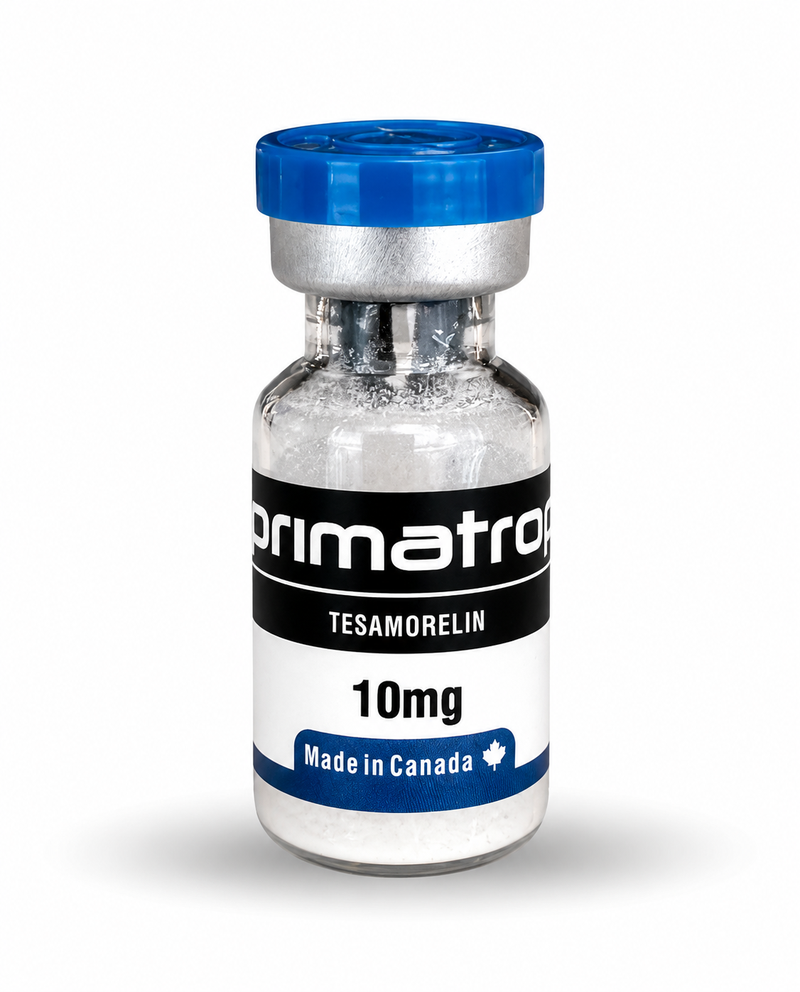
Tesamorelin-primatropin
Product Specifications
Product Name: Tesamorelin
Brand: Primatropin
Peptide Type: Growth Hormone-Releasing Hormone (GHRH) Analogue
Format: Lyophilized Powder
Strength: 10mg/vial x 1 vial
| Mix & Match Bulk Discount |
|---|
| Buy 5 - 10 Quantities Get $5 Off Each Item, |
| Buy 11 - 24 Quantities Get $10 Off Each Item |
| Buy 25+ Quantities Get $15 Off Each Item |
Description
Tesamorelin by Primatropin: Growth Hormone Regulation and Peptide Research
Tesamorelin is a synthetic peptide that has attracted scientific interest for its role in growth hormone regulation, visceral adipose tissue metabolism, and endocrine function.
As a growth hormone-releasing hormone (GHRH) analogue, Tesamorelin acts on the body’s natural hormonal signaling pathways rather than functioning as an externally administered growth hormone.
Researchers have investigated Tesamorelin’s ability to stimulate endogenous growth hormone secretion and influence metabolic processes associated with abdominal fat distribution.
Unlike many investigational peptides, Tesamorelin also has an established clinical research history, including studies involving adults with HIV-associated lipodystrophy.
Primatropin Tesamorelin, featured within the peptide selection at Nexgen Pharmaceuticals, relates to this area of endocrine and metabolic research.
Understanding its biological mechanisms, clinical evidence, and safety considerations provides important context for evaluating Tesamorelin.
What Is Tesamorelin?
Tesamorelin is a synthetic analogue of human growth hormone-releasing hormone (GHRH).
GHRH is naturally produced by the hypothalamus and communicates with the pituitary gland to regulate growth hormone secretion.
Growth hormone plays an important role in several physiological processes, including:
- Protein metabolism and tissue maintenance
- Lipid metabolism and fat distribution
- Regulation of insulin-like growth factor 1 (IGF-1)
- Cellular growth and metabolic signaling
- Normal endocrine function
Tesamorelin was developed to stimulate the growth hormone-releasing hormone receptor while providing greater stability than naturally occurring GHRH.
Its ability to increase growth hormone and IGF-1 concentrations has made it relevant to research involving metabolic disorders and abnormal fat distribution.
In the United States, prescription Tesamorelin formulations have received FDA approval for reducing excess abdominal fat in adults with HIV-associated lipodystrophy.
However, this approval does not extend to general weight loss, bodybuilding, or anti-aging applications. Access Data FDA
How Does Tesamorelin Work?
Tesamorelin works by activating growth hormone-releasing hormone receptors located in the anterior pituitary gland.
This stimulation promotes the release of endogenous growth hormone.
Growth hormone subsequently influences multiple metabolic processes, including the production of IGF-1, primarily through the liver.
The resulting hormonal activity can influence lipid metabolism and other physiological functions.
The Tesamorelin Mechanism of Action
Tesamorelin’s biological activity can be understood through three interconnected processes.
1. GHRH Receptor Activation
Tesamorelin binds to GHRH receptors in the pituitary gland, stimulating growth hormone secretion.
2. Growth Hormone and IGF-1 Signaling
Increased growth hormone activity stimulates downstream signaling pathways, including IGF-1 production.
3. Lipid Metabolism
Growth hormone influences the metabolism of stored fat, including processes associated with visceral adipose tissue.
These mechanisms explain why Tesamorelin has been studied in metabolic and endocrine research.
However, its effects on specific clinical outcomes depend on the population being studied and cannot be generalized to all individuals.
Tesamorelin Research and Scientific Applications
Scientific investigations involving Tesamorelin have primarily focused on its influence on abdominal fat distribution, growth hormone secretion, and metabolic physiology.
1. Visceral Fat and Abdominal Adipose Tissue
One of the most extensively studied applications of Tesamorelin involves visceral adipose tissue.
Visceral fat is stored within the abdominal cavity around internal organs.
Unlike subcutaneous fat, which is located directly beneath the skin, excessive visceral fat is associated with certain metabolic and cardiovascular risk factors.
Clinical trials involving adults with HIV-associated lipodystrophy demonstrated that Tesamorelin treatment could reduce visceral adipose tissue.
These findings supported the development of FDA-approved prescription Tesamorelin formulations for this specific medical indication.
Importantly, Tesamorelin is not approved as a general weight-loss medication. Its prescribing information describes it as having a weight-neutral effect. DailyMed
2. Growth Hormone Regulation
Tesamorelin has also been investigated for its effects on endogenous growth hormone secretion.
Rather than supplying growth hormone directly, the peptide stimulates the pituitary gland through GHRH receptor activation.
Researchers use this mechanism to better understand endocrine signaling and growth hormone regulation.
3. IGF-1 and Metabolic Signaling
Insulin-like growth factor 1 is an important mediator of growth hormone activity.
Research involving Tesamorelin has demonstrated increased circulating IGF-1 concentrations.
IGF-1 participates in cellular growth, tissue metabolism, and other physiological processes.
However, persistently elevated IGF-1 may present safety concerns, making appropriate clinical monitoring essential in approved treatment settings.
4. Liver Fat and Metabolic Research
Researchers have investigated Tesamorelin in relation to liver fat accumulation, particularly among individuals with HIV-associated metabolic abnormalities.
These investigations examine whether changes in visceral adipose tissue and growth hormone signaling are associated with changes in hepatic fat.
Although some studies have reported promising findings, additional research is necessary to establish broader clinical applications.
Tesamorelin should not be considered an established treatment for fatty liver disease outside its approved indications.
5. Aging and Endocrine Function
Growth hormone secretion naturally changes with age.
This has generated scientific interest in compounds that influence growth hormone pathways.
However, evidence does not establish Tesamorelin as a safe or effective anti-aging treatment.
Its ability to stimulate growth hormone production should not be interpreted as proof of improved longevity, physical performance, or age-related health outcomes.
Tesamorelin vs. Other Growth Hormone Peptides
Tesamorelin is frequently discussed alongside other peptides involved in growth hormone signaling, including CJC-1295 and Ipamorelin.
Although these compounds may influence related endocrine pathways, their mechanisms and available clinical evidence differ.
Tesamorelin: A GHRH analogue with an established clinical history involving HIV-associated lipodystrophy.
CJC-1295: A synthetic GHRH analogue investigated for its effects on growth hormone and IGF-1 secretion.
Ipamorelin: A growth hormone secretagogue that acts through the ghrelin receptor rather than the GHRH receptor.
These distinctions are important when interpreting published research.
Clinical findings involving one compound cannot automatically be applied to another.
Likewise, the regulatory approval of a specific prescription Tesamorelin formulation does not establish that other commercially available formulations have equivalent quality, effectiveness, or safety.
Primatropin Tesamorelin: Product Information
Primatropin Tesamorelin is identified as a peptide product within the Nexgen Pharmaceuticals brand selection.
Tesamorelin is a synthetic peptide, and product-specific characteristics should be confirmed through manufacturer documentation.
Relevant technical specifications include peptide identity, ingredient quantity, formulation, and analytical testing.
For lyophilized peptide products, factors such as manufacturing quality, purity, and appropriate storage conditions can influence product stability.
Published research involving prescription Tesamorelin should not be interpreted as independent verification of the Primatropin formulation.
Accurate product information is essential for distinguishing a particular commercial preparation from the pharmaceutical formulations investigated in clinical trials.
Tesamorelin Safety and Regulatory Considerations
Tesamorelin affects important hormonal pathways, and its administration carries potential risks.
FDA-approved prescription formulations include warnings involving elevated IGF-1 concentrations, fluid retention, glucose intolerance, hypersensitivity reactions, and potential concerns involving malignancies.
Tesamorelin is also contraindicated in certain circumstances, including pregnancy, active malignancy, and specified disorders affecting the hypothalamic-pituitary axis.
Its long-term cardiovascular safety has not been established.
These considerations emphasize the importance of distinguishing regulated prescription medicines from products whose quality, safety, or regulatory status has not been independently established. DailyMed
In Canada, regulatory status must be evaluated for the specific product rather than inferred from approval of another Tesamorelin formulation in the United States.
Frequently Asked Questions About Tesamorelin
What is Tesamorelin?
Tesamorelin is a synthetic growth hormone-releasing hormone analogue that stimulates endogenous growth hormone secretion through receptors in the pituitary gland.
What is Tesamorelin primarily studied for?
Tesamorelin has been extensively studied for reducing excess visceral abdominal fat in adults with HIV-associated lipodystrophy. Researchers have also investigated its effects on growth hormone secretion, IGF-1, and metabolic function.
Does Tesamorelin help reduce abdominal fat?
Clinical trials have demonstrated reductions in visceral adipose tissue among adults with HIV-associated lipodystrophy. These results do not establish Tesamorelin as an effective general weight-loss treatment.
What is the difference between Tesamorelin and Ipamorelin?
Tesamorelin stimulates GHRH receptors, while Ipamorelin activates ghrelin receptors. Both influence growth hormone signaling, but they operate through different biological mechanisms.
Is Tesamorelin approved for anti-aging?
No. Tesamorelin is not FDA-approved for anti-aging, longevity enhancement, bodybuilding, or general physical performance.
Where can I find information about Primatropin Tesamorelin in Canada?
Nexgen Pharmaceuticals features Primatropin within its peptide selection. Readers should review available product specifications and relevant scientific research when evaluating information about Tesamorelin.
Final Thoughts: Tesamorelin and the Future of Peptide Research
Tesamorelin represents an important area of research into growth hormone signaling, visceral fat metabolism, and endocrine physiology.
Its established clinical history distinguishes it from many peptides that remain primarily investigational.
Research has demonstrated meaningful effects on visceral adipose tissue in a specific patient population, while broader applications continue to require careful scientific evaluation.
Understanding the distinction between established clinical evidence and emerging research is essential when examining peptide compounds.
Explore additional information about Primatropin and peptide research at Nexgen Pharmaceuticals.
Disclaimer: This content is intended for educational and informational purposes only. It does not constitute medical advice. Clinical findings involving approved prescription Tesamorelin formulations do not establish the safety or effectiveness of other commercially available products. Consult a qualified healthcare professional for medical guidance.
Reviews (0)
Only logged in customers who have purchased this product may leave a review.
Reviews
There are no reviews yet.
-
0 Reviews